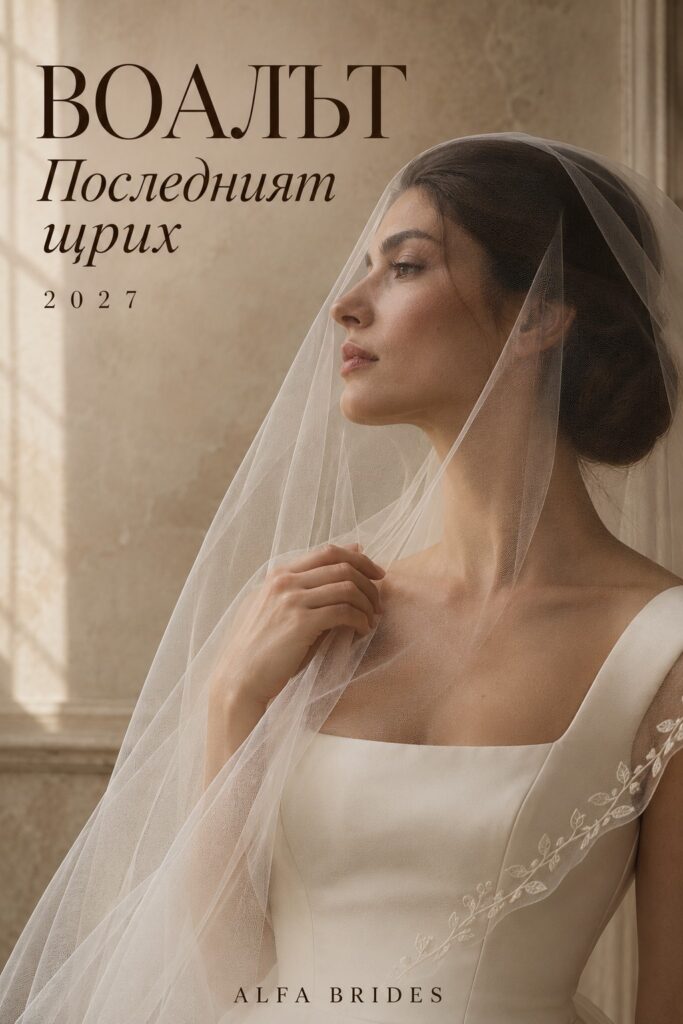
There is a moment in the fitting room that photographs can never quite prepare you for. The wedding dress has been chosen, the silhouette feels right, and family and friends have shared their opinions. Then the veil goes on. The woman looks in the mirror again — this time a little longer.
A white dress can be beautiful on its own. With the veil comes the feeling that the wedding is getting close. For many women, this is the first moment they truly see themselves as a bride.
Emotion, however, does not replace a considered choice. One veil will reveal the back of a gown; another will conceal it. A lace border can frame the train beautifully or disappear against its decoration. Even the same length looks different depending on your height, hairstyle and where the veil is secured.
That is why a veil should be chosen while wearing the dress. At Alfa Brides in Sofia, this is how we pair our luxury bridal veils by Poirier and the Randy Fenoli designer collection with our bridal gowns.
For a Simple Wedding Dress: Lace for Romance, a Satin Edge for Definition
A gown in smooth mikado, satin or crepe offers the greatest freedom when choosing a veil. Against an uninterrupted fabric, decoration becomes clearly visible and can change the character of the entire look.
To preserve the gown’s clean, architectural feel, choose sheer tulle with a plain edge or satin trim. A satin border defines the veil and echoes the smooth lines of the fabric. One example in the Alfa Brides selection is Randy Fenoli S705 300 1, a single-tier veil with a satin edge.
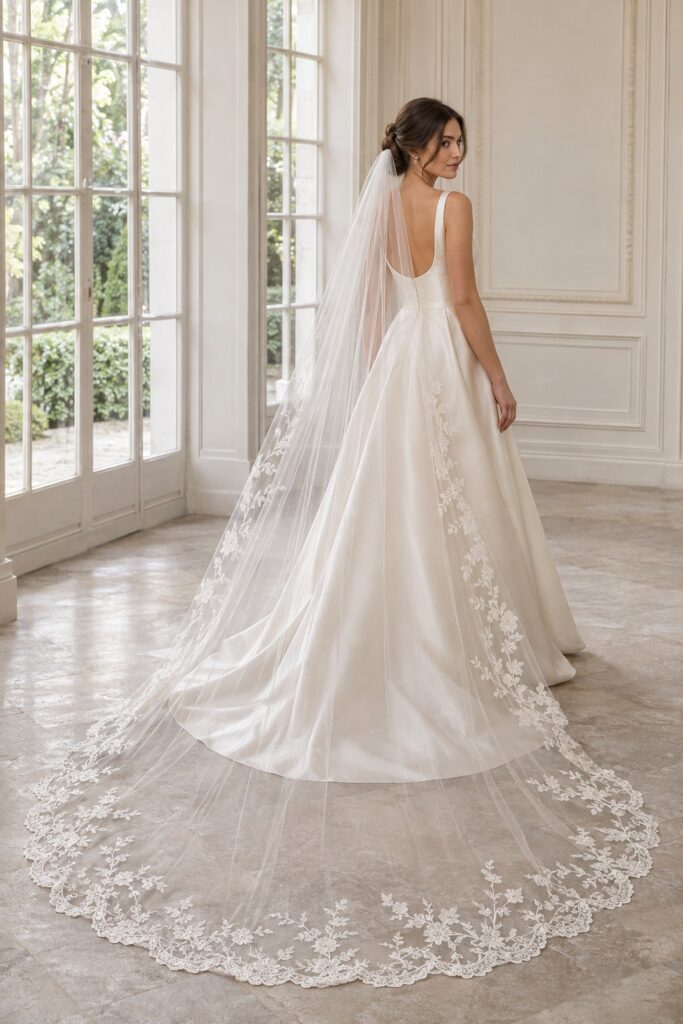
For a more romantic effect, consider a long veil with a lace border. Randy Fenoli S702 280 1 is made from soft tulle, measures 280 cm and features an embroidered floral edge beginning around elbow level. This keeps the neckline relatively clear while allowing the lace to unfold alongside the skirt.
It is a particularly effective pairing with a structured bodice and a plain skirt: the construction remains visible, while the veil introduces the decorative detail.
For a Lace Wedding Dress: Related Motifs or Plain Tulle
With a lace gown, the first decision is whether to continue the ornament or let the dress remain the main focus.
For a richly embellished design, a plain single-tier veil is a reliable starting point. It adds length and transparency without layering another dense pattern over the lace.
If you prefer a lace veil, compare the motifs closely. Large flowers on the dress do not always sit comfortably beside a small, intricate veil border. Thread colour, the texture of the embroidery, and the presence of pearls or sequins also matter.
Poirier S50 280 1 is a single-tier, 280 cm veil with a substantial lace border decorated with pearls and sequins. With a lace dress, we select it after comparing the patterns. With a smooth gown, it can carry the entire decorative element of the look.
Check the combination from behind, too. When two elaborate borders finish directly on top of one another, some of their detail is lost. A longer veil or a simpler edge can often resolve this.
For a Ball Gown: Length That Extends the Silhouette
A full skirt already establishes the proportions of the bridal look. The veil needs to work with that volume, as well as with the detail around the shoulders.
A long single-tier veil is a good choice when you want an elongated silhouette. It falls over the skirt and spreads behind it, extending the overall line.
A two-tier veil creates a different effect: the shorter layer adds fullness around the head and face. It suits a bride who enjoys a more elaborate ceremonial look.
A short veil can also work with a ball gown, but its finishing point needs careful attention. A heavy border falling across the widest part of the skirt may visually divide it. Sometimes a few centimetres make all the difference.
For Mermaid and Fit & Flare Dresses: Transparency That Reveals the Cut
With these wedding dress silhouettes, the defining features are the fit through the waist and hips and the point at which the skirt begins to flare.
We therefore start with a single-tier veil with a sheer central section. Decoration can sit along the edges or low around the train, allowing the lines of the dress to remain visible through the tulle.
Soft tulle falls closer to the body and works well when the aim is to preserve the silhouette. More structured tulle creates volume of its own. It can also be effective, but needs to be assessed with the particular gown.
For a heavily embellished mermaid dress, a plain veil is a sensible first choice. With a smooth design, there is more room for lace or a crystal border.
For an Open Back or Lace Sleeves: Decoration That Starts Lower Down
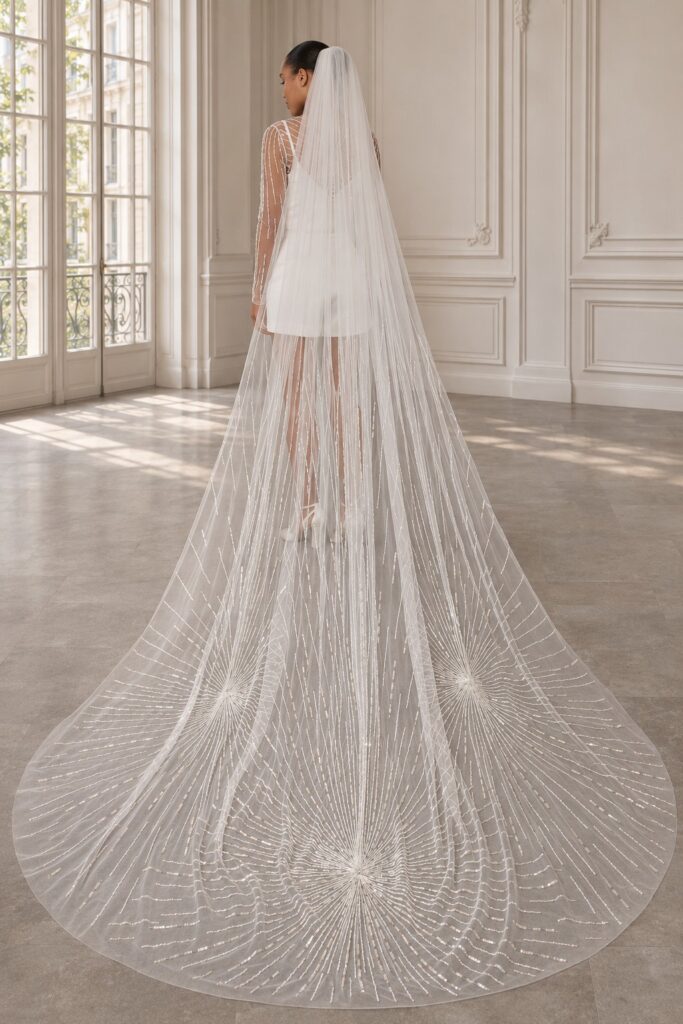
If a beautiful back was one of the reasons you chose your dress, it deserves to remain visible. Fine single-tier tulle with a clear central section is a suitable option. The same principle applies to lace sleeves: dense veil decoration around the shoulders can obscure their craftsmanship.
Randy Fenoli S701 300 1 is a good example. This 300 cm veil is made from soft tulle, with an embroidered floral border, pearls and sequins. The lace begins around elbow level, keeping the upper section lighter while the decoration develops alongside the skirt.
The position of the comb matters, too. Secured above or below a bun, the same veil will cover the back differently. Your hairstyle should therefore be considered during the selection.
Why Choose a Short Veil?
A short veil draws attention to the face and the upper part of the dress. It leaves the skirt visible and works well with short bridal dresses, defined waistlines and looks with a vintage influence.
There is a practical advantage, too: when the tulle stays above the floor, movement is easier and there is no long train to arrange behind you.
A shorter length can still carry elaborate decoration. Poirier S50 075 2 measures 75 cm and features a lace border with pearls and sequins, plus an additional layer that can cover the face. Its decoration sits close to the shoulders, so it needs to be considered alongside the neckline, sleeves and jewellery.
Why Choose a Long Veil?
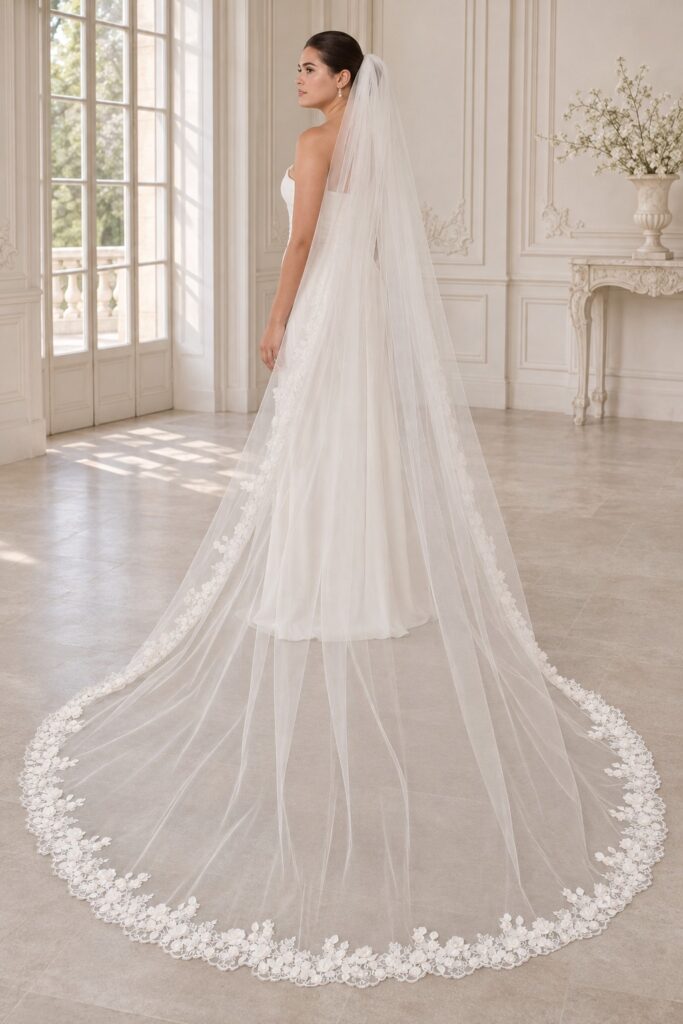
A long veil changes the bride’s entrance. The tulle unfolds behind her, creating a line that becomes visible in movement and in wider photographs of the ceremony.
It works with dresses both with and without a train. With a train, it extends the composition; without one, it supplies ceremonial length of its own.
Compare actual measurements when choosing. Terms such as chapel and cathedral can vary between manufacturers. What matters most is where the veil finishes in relation to your dress.
If both edges are richly decorated, allow enough separation for each pattern to be seen. There is no universal measurement: the right distance becomes clear when the dress and veil are laid out together.
Why Choose a Two-Tier Veil?
A two-tier veil has two clear functions. It adds fullness around the face and, in designs made for this purpose, allows the shorter layer to be brought forward as a blusher during the ceremony.
It is the choice for a bride who wants that traditional moment or prefers a fuller frame around her head.
With bare shoulders, two layers can create beautiful softness. With a high neckline, voluminous sleeves or large flowers around the bodice, they require more careful consideration because several details occupy the same area.
If your priority is to reveal the back and construction of the gown, start with a single-tier design.
Luxury Randy Fenoli Veils at Alfa Brides
In the Randy Fenoli collection, created in collaboration with Poirier, the craftsmanship deserves a closer look. Fine tulles, exceptional lace, and hand-sewn beads and crystals on embellished designs give each veil its distinct character.
Some designs focus on floral embroidery. Others draw attention to the light reflected by a crystal border. Others finish with a clearly defined satin edge.
Randy Fenoli S703 300 1 is a single-tier, 300 cm veil with crystals and stones along its border. With a simple dress, it creates a sparkling frame. With a crystal-embellished gown, it should be selected after comparing the size, tone and density of the stones.
The placement of the decoration matters as much as its quality. A well-positioned motif directs the eye towards the face, the waist or the end of the train. That is why an embellished veil should be viewed both close up and from a distance.
Bridal Veil Trends for 2027
Pearl borders, floral embroidery and sparkle worked into decorative motifs stand out in Poirier’s current designs. These offer several directions for a 2027 bridal look, with the choice guided by the dress.
Pearls Along the Edge
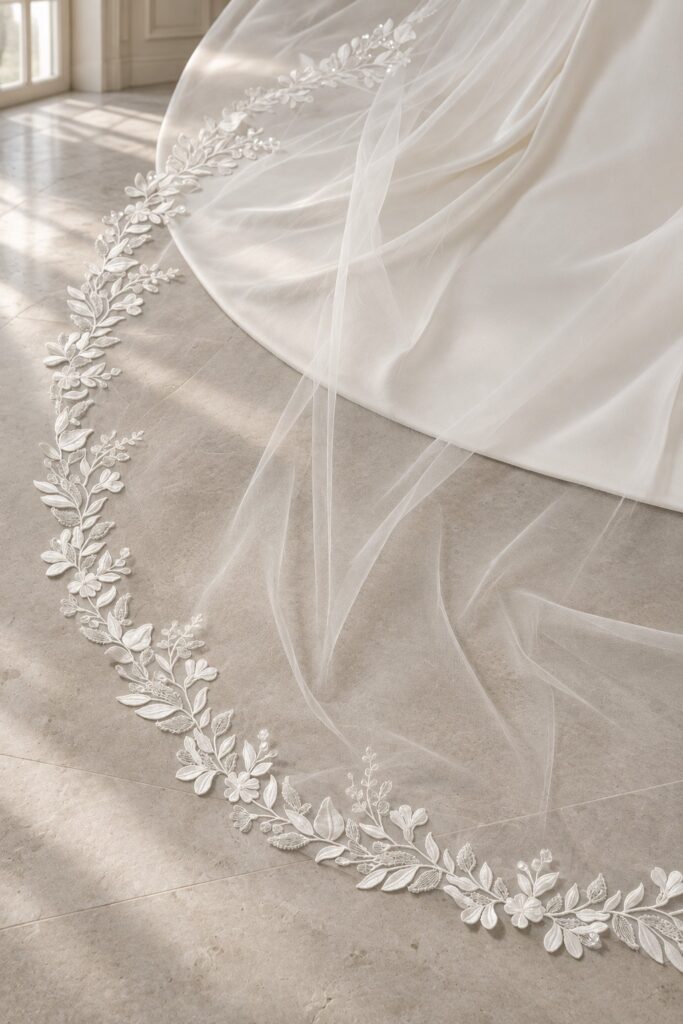
A pearl border defines the veil while leaving its centre transparent. On Poirier S442-300/1/SOFT, pearls of different sizes follow the edge, starting at the comb.
This style pairs well with smooth satin, mikado or a gown with delicate pearl details. Compare the colour and size of the pearls on both pieces to make sure they work together.
Flowers and Embroidered Branches
Floral motifs appear both along the borders and across larger areas of tulle. Poirier S476-280/1/SOFT features an embroidered floral motif, while S464-300/1/MED has lace flowers throughout.
With a simple A-line gown, this kind of veil can become the main feature. With a lace dress, the motifs need to be compared to avoid an overly dense overlap.
Sparkle Within the Lace
On Poirier S475-300/1/MED, sequins are incorporated into a pattern of flowers and leaves. As the bride moves, the light catches the embroidery.
It can complement a romantic gown with subtle shimmer or bring richer decoration to a plain dress.
Embellished Veils in More Compact Lengths
Expressive decoration also appears on shorter designs. Poirier S112-120/1/SOFT measures 120 cm and combines embroidered flowers and branches with beads and sequins.
It is an option for brides who want an ornate veil while keeping the skirt visible and avoiding tulle trailing across the floor.
These designs illustrate the directions within Poirier’s catalogue. Availability and ordering options can be confirmed with Alfa Brides.
The Final Fitting Should Include the Dress
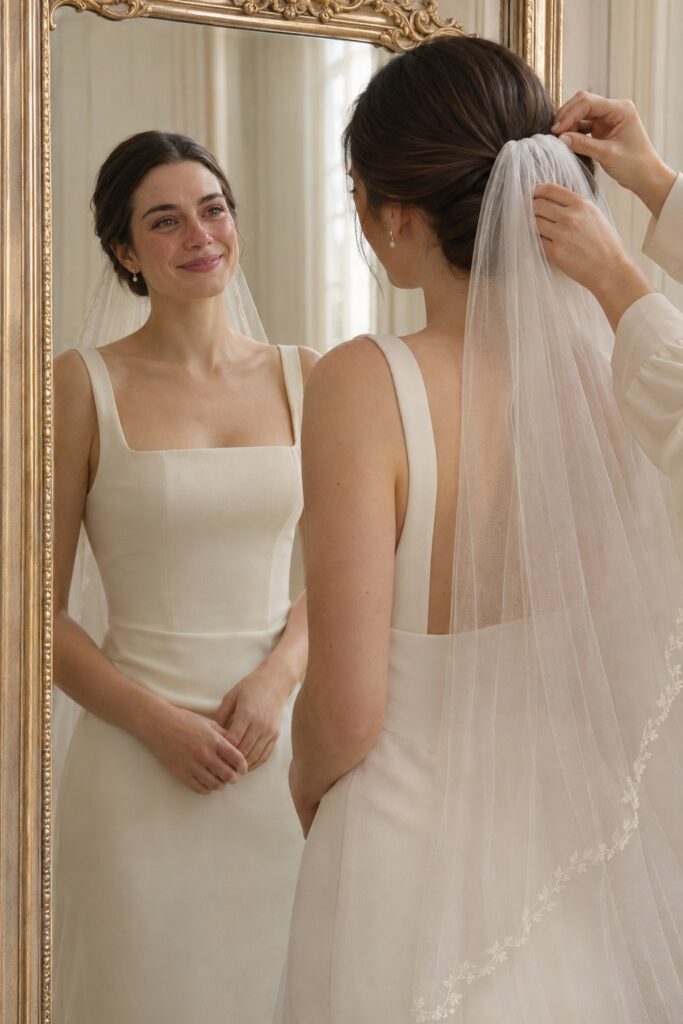
Before making your decision, place the tulle against the dress fabric and compare their colours. Check how the borders sit in relation to one another. Walk, turn and look at a photograph of the back.
The veil should also work with your hairstyle. Its attachment point changes the effective length, the fullness around the shoulders and how much of the dress remains visible.
At Alfa Brides in Sofia, you can compare our luxury bridal veils by Poirier and Randy Fenoli with your chosen wedding dress.
Give yourself time to look properly. Sometimes those final metres of tulle are what make the wedding suddenly feel real.
Follow us on Instagram, Facebook and TikTok.